Sunday, November 9, 2008

Norman Rockwell


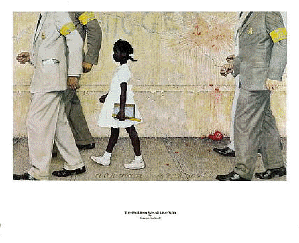
This portrait titled, The Problems We All Live With, was painted in 1964 by artist Norman Rockwell. This painting, although not seemingly significant by the first glance, gains much more importance with an increase in understanding of the particular cultural context in which it was written. Norman Rockwell did not simply paint this picture for aesthetic appeals, it was painted with purposeful visual argument to create an argument about the current situations about the time.
In 1954, the case Brown vs. Board of Education, the case 1896 Plessy vs. Ferguson which allowed for segregation of blacks and whites was overturned (http://brownvboard.org/summary/). Whites and blacks were no longer to be forced to attend separate schools. However, due to many racial feelings and tensions still present in the Southern United States, many schools and towns failed to enforce this court decision, and segregation was still a very real part of daily life for blacks in these times. This time is also characterized by the movements of famous African Americans like Martin Luther King Jr. who were influential in the civil rights movement. However, this painting deals more specifically with the story of Ruby Bridges.
Ruby Bridges was chosen by the http://www.naacp.org/ to be one of the first young black students to enter into the all white public schools as a way to enforce the rulings of Brown vs. Board of Eduacation (http://www.ci.troy.mi.us/law/LawDay2004/TheProblem.asp). It is this rare situation or moment that Norman Rockwell is able to capture and freeze in time in his visual rhetoric.
Through many means of visual cues, Rockwell depicts the scene of Ruby Bridges walking to school and manages to capture the feelings of emotion of the angry whites, as well as the awkwardeness of the situation. The splattered tomato, often thrown in the culture of this time by audience members who disapprove of the performance being acted out, is a subtle but effective reminder of the displeasure most of the whites found in this government action. The word "nigger" scrawled on the wall in graffiti style behind ruby, also culturally significant since it is a word very deragatory of African Americans, also contributes to develop and argue the feelings of tension in the audiencs. Even the white dress ruby is wearing contrasts with the color of her own skin, in some ways pointing out that that is the sole issue of the situation. The men in suits function as governemental aid that is necessary to "force" this action. Even the title of the painting, The Problems We All Live With, plays a significant role in the argument.
Interestingly, all these visual cues that are part of the text and significant through the cultural context can be interepreted in many ways by the audience. The "problems" to the audience could be the feelings of racism towards the black that the blacks have to deal with, or they can also be the feelings of being wronged or stolen from that many of the whites may have felt.

Monday, November 3, 2008

Urban Ninjas

These guys are totally freakin' dulce! Urban Ninjas, have you heard of them or seen them? I think it is absolutely amazing the things that they can do. They are athletic, well-oiled machines. I am sure that it takes hours upon hours of practice to not only learn how to do the basic flips and things that they do, but to develop the reflexes, timing, and distance judging abilities that they use. It is phenomenal that they are able to jump off such high buildings and time their roles and landings so that the shock and weights of their bodies are distributed so that they are completely unhurt. It is also incredible how strong and flexible they are, the distances they jump and are still able to hold on to ledges, the core strength it takes to maneuver their bodies, and all the things they do take days, weeks, months, and years to develop. People aren't simply born with the ability to broad jump ten feet and do one armed pull-ups, those type of skills take aches and pains.
Injuries are surely a way of life. I wonder how many bones these guys have broken, ligaments they've torn, and muscles they've pulled. I doubt any of them have been injury free. Scratches, bumps, bruises, and stitches are probably part of their everyday lives.
These guys are extremely good at something, just one particular thing in life. I hope that someday I will have that; I hope that I will be able to call myself one of the best in some skill or area. I think that everyone should have a goal like this in their lives. They should work to be so good at something that people actually stop to notice and comment on their particular skill. It is not necessary that this particular skill is money making, funny, or athletic, it should simply be an expression of self. Striving to similar is a common problem. Our high schools and many other areas of society are filled with people who want to blend or fit in. I think we should embrace distinctiveness and individuality. We should make it a priority to define ourselves by our own perceptions rather than base them off of others.

Sunday, November 2, 2008

Clay Dyer is an absolutely amazing person. What an inspirational person. He is a professional bass fisherman, and a very good one. The thing that is so amazing about him is that he does all this without any arms and legs. He uses every part of himself to go fishing, he holds nothing back, doesn't need any motivation, except for himself.

He doesn't let his disabilities get to him. He makes good out of the unfortunate events in his life.

Inevitably, there is a garbage truck in each person's life. At some time in each person's life, this garbage truck is going to back up and dump its trash all over you. It is going to limit each person in their own special way. Each person has a choice to either sit in the garbage, and stink, smell, and rot just like that garbage and become garbage; or, they can use that garbage, over come that garbage, make good out of that garbage just like Clay Dyer has. His garbage, his series of unfortunate events seem overcomeable to most people. But he has overcome his garbage in such a dramatic fashion that he can be an inspiration in almost every person's life. He can inspire people to look at what they've got, and rejoice in those gifts and use them to do good things.

There are two verses in the Bible that I am reminded of when thinking about Clay Dyer. The first is Luke 12:48 "To whom much is given much is expected." the second is from 1 Corinthians and it is the verse about their being many parts but only one body. I think that Clay fits these verses very well, and in some ways can make many people feel guilty. Most people would agree that they have been given much more in their lives than Clay, but they haven't done anything as impressive as he. Clay has also played his role in the body (community), very well. He has played the role of an inspirer in the body, maybe you could call him adrenaline. He inspires people to use their gifts to benefit the body just like Clay has.

Sunday, October 26, 2008

Sarah Palin


The 2007 Vice-Presidential was at Washington University in St. Louis University. Random fact, my best friend from high school goes to Wash U and is in an A Capella singing group on campus. The group wrote a song about this years campaigns and upcoming elections. NBC's morning show crew was on campus the morning before the debate and the group got to sing on the show. So my best friend was on National Television for 1:42 seconds!

Anyways, the debate followed my friends prime time and the question was asked, "Due to the recent bailout plan, what promises that you've made are you going to be unable to keep." Sarah Palin did a great job developing and employing her use of pathos in addressing and answering this question.

First of all she created various feelings of repungence towards Senator Obama and his running mate Senator Biden. Occasions where she created this feeling often resulted through her emphasis of specific words while describing events about the energy crisis. She said, "THAT'S what gave those oil companies those tax breaks." She places emphasis and clearly pronounces that word that's while refering to Obama's vote for the 2005 energy plan which creates the idea that Obama was directly related to the problems that resulted from the plan. Therefore, by her use of a negative tone of words and emphasis on particular ones, she creates a feeling or mood of resentment towards senator Obama. The emotion that she has presented and created create a motivation for a reaction in the audience that wants to move away from Senator Obama and the particular ideas and issues that he stands for according to Palin.

She immediately follows this by describing how she had to break up the monopolies of the big oil companies in her state that resulted from the plan. She continues to place emphasis on particular words in this dialogue, particularly the words "I and my." At one point she says, "I had to turn things around, ... [and] I had to say, 'You know the people are going to come first. Taxbreaks aren't going to come to big multinational coorporations when they adversely affect people." This use of the word I is slightly connected to her use of ethos, but it has an overall pathotic effect. She creates a feeling of desire in the audience by her use of first person. People experiences of attractiveness or being drawn to Palin because she seems to have all the answers and to be doing the right things. Palin further builds on these feelings on the audience and in a way stamps those feelings with legitamacy by bringing in her own feelings about things that "adversely affect people." To the audience, the are the people. They are the ones that Obama and multinational businesses are surpressing. Therefore, a slight emotional patriotism seems to arise. The audience feels that by moving away from Obama and towards Palin not only will they be helping themselves, bu they will be helping the country and all the other citizens of the U.S. in the right directions.

Towards the end of her answer, Palin is able to further affirm the desires, resentments, and feelings she has created for the audience by displaying some of her own emotions. She uses a joke "How long have I been at this, five weeks?" to ethotically build pathotic feelings of humor. She creates an image of herself as a normal person, like the rest of the audience. This helps to further explain and legitimize her use of words such as "for the good of the country" and for the "people" because unlike the dull politicians, Obama and Biden, she is a person and knows what the audience is going through. She therefore creates an emotional feeling of connection and understanding in the audience to finish of her answer. Palins use of pathos is firmly evident in her answer, and it is exceptionally well developed.

Tuesday, October 21, 2008

FinalDebate: Question Roe vs. Wade

In the third and final presidential debate, Senators McCain and Obama, the final two presidential candidates, were asked for their opinion about Roe v. Wade, and how that opinion would effect decisions in selecting supreme court justices during their possible presidential term. Each candidate used applied ethos, pathos, and logos in a slightly different manner. Much of this seemed to be based on their particular personalities and their overall outlook on the issue at hand.

Senator McCain seemed to rely heavily on the employment of ethos and pathos. He employs ethos, the use of his own legitimacy, very strongly and consistently throughout his answer. He persuades the audience by stating who he is, how he feels, and how those feelings will affect his decisions. Throughout his answer, he constantly builds up this idea of him as a the president by saying things like, "I believe, I did, I voted, I am. " He tells the audience exactly how he feels about the subject. One particular example of McCain building upon his ethos is when he says, "I voted for justice." He implies here that he made the right decision and can continue to make those decisions.

In doing this he is also strongly providing pathos to his persuasion. His use of first person, and the tone of voice he uses makes it seem that this issue is important to him personally as a U.S. citizen rather than simply the election process. His use of I depicts a picture of himself that fully illustrates the fact that Roe v Wade is wrong, and he even goes as far to say that he does not believe a person in favor of abortion can be qualified as a Supreme Court Justice. The inflections of his voice, and his movements of his hands (the little two finger scrunch thing to say Obama afraid of so called conservative judges) further help to create this emotional outpouring in McCain's answer that is easy to grasp upon and evoke feelings of sympathy in the audience.

McCain does use logos a little in his persuasion, but nearly as much as Senator Obama. His logic comes in while he is stating that elections and nominations of Supreme Court justices a very important things and that they impact the overall out look of our nation. He brings in reasoning at another moment of his answer when he says that he would base his nominations of Supreme Court justices on their qualifications. This seems very logical to pick someone based upon their past qualifications rather then their genetic or intelligent potential.

Obama employs logos as his main tool in his persuasion. He continually applies to logic by his statement of facts and their applications to the Constitution and his use of a more passive tone. He does not seem to be emotionally excited and personally into this question like Senator McCain had been. He keeps an even tone without raising or inflecting his voice to apply emotional appeal to any particular detail. He uses eloquent yet simple language that also helps his persuasion through logos.

By presenting a point in third person, "It is true this is," rather than presenting something as I believe or think, he makes his facts seem more legitimate he builds his ethos. He sounds informed. It seems like he doesn't have a particular opinion about the issue in a yes or no manner. He simply has facts and evidence that are his knowledge and his opinion. To him they are indisputable and, therefore, he is unable to believe anything else. This use of ethos and logos appeals to the audience because it persuasively paints an image of Obama as a president who makes decision based on facts and statistics rather than his own opinions.

Although Obama rarely uses pathos or emotional appeal into his persuasion, near the end of his answer he tells the story of Louey Ledbetter. He describes her undesirable situation in life caused by unfairness created through a lack of responsibility in the U.S. governmental decision. He uses this story to build feelings of sympathy for this woman rather than himself. This becomes very effective as he turns these feelings of sympathy into resentment towards McCain when he says that McCain voted against supporting her, while he voted in support of her.

Each candidate chose a different rhetorical path in answering the question. Obama chose the smooth talking all business no nonsense logical route, while McCain chose the emotional and personal opinion route depicting this issue as one that effects everyone including him, a seemingly typical American Citizen. It is not apparent which candidate's use of rhetoric was more effective, it is simply apparent that each's differed.