Tuesday, November 25, 2008
"I Want Candy" by Aaron Carter: Brandon's Favorite Music Video
In this video we are introduced to a handsome Aaron Carter, and his teenage crush that "sets his heart on fire" Candy. Within the video, the editing and filming styles work/employ a relaxed or nonprofessional approach in appearance. Scenes within the video are deliberately made short and choppy with a lack of any clear cut smooth transitions. In general, the angles used in the filming are abstract/tilted as if taken using a home video. This home video appearing aspect is important to the overall argument of the hybrid text. This quality helps to create and tell the story of Aaron and his teenage crush on candy through his youthful eyes. In the opening phone conversation, a pathetic appeal is created that causes Aaron to appear nervous yet excited for his date with Candy. Through this pathetic appeal and the seemingly unprofessional methods of filming, the youthfulness that characterizes Aaron and Candy's relationship, one that is present in nearly all teenage crush based relationships, is developed as we see them attempting to participate in romantic activities.
Within the video there is a recurring pattern of Aaron's friends habits of busting his and Candy's romantic moments. This may be an attempt to develop an effective ethos in Aaron's favor, by showing his ability to have friends but also his maturity level that may be slightly higher than theirs because he is on the date. Furthermore, the introduction of Aaron's friends and there frequent busting/tampering in of Aaron and Candies moments of romance my expand the argument of the youthfulness that is present in Aaron and Candies relationship. This is mainly a result of the friendships that appear to be strong between Aaron and his still youthful and immature appearing friends.

Sunday, November 23, 2008
Tuesday, November 18, 2008
"The Problem We All Live With"

For many Americans, the 1950’s and 60’s contain memories of the fears and confusions created by the Cold War. But for some, these years hold memories of a war against racism that was fought at home within American borders known as the Modern Civil Rights Movement. The names of many African Americans, such as Martin Luther King Jr., Rosa Parks, Malcolm X, and Ruby Bridges, have been engraved into U.S. History for the roles they played in the movement. The 1954 case, Brown vs. board of education, and the 1964 Civil Rights Act signed by President Johnson held that racial segregation in schools was unconstitutional and prohibited discrimination against people of all types, it overturned the 1896 Plessy vs. Ferguson case, and provided the federal government with the power to enforce desegregation (Brunner). Each of these people, acts, and cases contributed to the argument that differences in race, skin color, or culture do not point to inferior or superiority; instead, they are simply differences. However, the idea that these differences are not bad, but in fact essential, is often overlooked. If everyone in a particular community fit the same role, the community as a body or whole would be missing parts that are necessary for its functionality. Therefore, each unique part is required for the overall success of a community.
In 1964, within some of the most violent years of the modern civil rights movement, artist Norman Rockwell painted the portrait titled, The Problem We All Live With. This portrait depicts the image of Ruby Bridges, a young African American schoolgirl, being escorted to a formerly all white school by four U.S. Marshals. Ruby Bridges was chosen by the National Association for the Advancement of Colored People (NAACP) to be one of the first young black students to enter into the all white public schools of New Orleans as a way for the federal government to enforce the rulings of Brown vs. board of education ("The Problem"). It is this rare situation or moment that Norman Rockwell captures and freezes in time through his visual rhetoric. However, the portrait does not simply narrate the situation taking place. Through the use of the rhetorical strategy of analogy, Rockwell’s portrait makes a rhetorical appeal to pathos that argues that the failure of different people and parts to function together leads to violent disfunctionality in the body or group as a whole.

The visual cues in The Problem We All Live With create an analogy that compares the situation of Ruby Bridges and the Modern Civil Rights Movement to war. The cause of war in general usually involves one group’s inability to live in association with another. Each feels like they have or deserve certain rights that cannot be taken from them; however, in most cases, these groups are selfish and want to keep freedoms and rights to themselves rather than to experience freedom in conjunction with numerous groups. This inability to accept that people could be functional parts of society despite their differences was the main cause of racism and the Modern Civil Rights Movement. Whites felt they could not be free while blacks were given similar rights and freedoms, and blacks felt that they were being suppressed from the freedoms they deserved. The result, according to this portrait, was war.

The arrangement of the tomato and the cracked, broken down wall it is splattered upon plays an important role in the portrayal of this scene as one that is analogous to war. The dark red, circular, splatter pattern left by the tomato looks eerily similar to human blood splattered from a bullet wound or some other war related injury. The wall’s cracked and holey look contribute to this analogy of war because it appears to have been riddled with bullets and mortars. By creating this analogy, a pathetic appeal of intense emotion is created. With war often come extreme feelings of pain, anger, hatred, sorrow, and resentment, all of which are created by the visual rhetorical strategy of analogy in The Problem We All Live With. These emotions are essential to the painting’s attempt to persuade the viewer to accept its main argument that inabilities within or between groups to accept differences, in this case racism, can ultimately lead to the pain and hatred often experienced in war.

The word “nigger,” which is scrawled graffiti style on the wall behind Ruby Bridges, continues this pathetic appeal to the audience by evoking even more intense feelings of emotion. “Nigger” is an extremely powerful word capable of evoking emotions on its own that is not commonly used in everyday language. It brings with it connotations of hatred, pain, and resentment towards blacks that is directly linked to black racism in America. By using this word, the viewer is shown that racism is the “problem” and reason for the analogous war taking place. Although no white protesters are depicted, their presence can be assumed due to the context with which the portrait was painted. It is obvious that the hatred and resentment that characterize the racism in the word “nigger” and that are analogous with the feelings associated with war are directed towards Ruby Bridges.
 She is arranged in the center of the portrait and its action; the contrast of her dark skin with the white dress she is wearing causes her to standout in the otherwise dull brown and grey colors that typify the portrait. The pathetic appeal taking place in this rhetorical situation seems to force the viewer to pick a side in the war. Join the protesters and fight for the right to allow segregation and keep the different parts separated, or join the U.S. Marshals and fight to protect and embrace uniqueness.

America has prided itself as being the land of freedom for all, full of diversity, and epitomized by a culture comprised of traditions that stem from nearly every part of the world. However, it is apparent that many of the prejudices of peoples from past countries have been integrated into the American culture along with those bigotries that have been developed within the United States. According to The Problem We All Live With, these biases are the cause of violent disunity within a group or entire nation. In 1 Corinthians 12, St. Paul says, “If a foot should say, ‘Because I am not a hand I do not belong to the body,’ it does not for this reason belong any less to the body… But as it is, God placed the parts, each one of them, in the body as he intended. If they were all one part, where would the body be?… The eye cannot say to the hand, ‘I do not need you,’ Indeed, the parts of the body that seem to be weaker are all the more necessary… so that there may be no division in the body, but that the parts may have the same concern with one another.” Therefore, it can be argued that to truly reach its potential success, Americans need to leave their preconceived notions behind and embrace the various ethnicities, skin colors, and distinctive parts that encompass their countries’ body.
Brunner, Borgna, and Elissa Haney. "Civil Rights Movement Timeline." Infoplease. 2007.
Pearson Education. 19 Nov. 2008
""The Problem We All Live With"" City of Troy. 30 Apr. 2004. 19 Nov. 2008
Sunday, November 9, 2008
Norman Rockwell
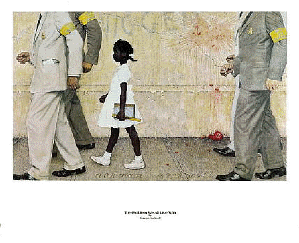
This portrait titled, The Problems We All Live With, was painted in 1964 by artist Norman Rockwell. This painting, although not seemingly significant by the first glance, gains much more importance with an increase in understanding of the particular cultural context in which it was written. Norman Rockwell did not simply paint this picture for aesthetic appeals, it was painted with purposeful visual argument to create an argument about the current situations about the time.
In 1954, the case Brown vs. Board of Education, the case 1896 Plessy vs. Ferguson which allowed for segregation of blacks and whites was overturned (http://brownvboard.org/summary/). Whites and blacks were no longer to be forced to attend separate schools. However, due to many racial feelings and tensions still present in the Southern United States, many schools and towns failed to enforce this court decision, and segregation was still a very real part of daily life for blacks in these times. This time is also characterized by the movements of famous African Americans like Martin Luther King Jr. who were influential in the civil rights movement. However, this painting deals more specifically with the story of Ruby Bridges.
Ruby Bridges was chosen by the http://www.naacp.org/ to be one of the first young black students to enter into the all white public schools as a way to enforce the rulings of Brown vs. Board of Eduacation (http://www.ci.troy.mi.us/law/LawDay2004/TheProblem.asp). It is this rare situation or moment that Norman Rockwell is able to capture and freeze in time in his visual rhetoric.
Through many means of visual cues, Rockwell depicts the scene of Ruby Bridges walking to school and manages to capture the feelings of emotion of the angry whites, as well as the awkwardeness of the situation. The splattered tomato, often thrown in the culture of this time by audience members who disapprove of the performance being acted out, is a subtle but effective reminder of the displeasure most of the whites found in this government action. The word "nigger" scrawled on the wall in graffiti style behind ruby, also culturally significant since it is a word very deragatory of African Americans, also contributes to develop and argue the feelings of tension in the audiencs. Even the white dress ruby is wearing contrasts with the color of her own skin, in some ways pointing out that that is the sole issue of the situation. The men in suits function as governemental aid that is necessary to "force" this action. Even the title of the painting, The Problems We All Live With, plays a significant role in the argument.
Interestingly, all these visual cues that are part of the text and significant through the cultural context can be interepreted in many ways by the audience. The "problems" to the audience could be the feelings of racism towards the black that the blacks have to deal with, or they can also be the feelings of being wronged or stolen from that many of the whites may have felt.
Monday, November 3, 2008
Subscribe to:
Posts (Atom)